Interdependence Theory
Satisfaction and commitment
It is framed by the rewards the other partner is able to provide, in decision of staying or leaving the relationship.
However, the evaluations on the rewards are not objective, but rather on the consistency between perceptions of rewards.
In relation to two kinds of standards – expectations about what benefits are deserved (comparison level or CL), and the perceived quality of available alternative partners or relationships (comparison level alternatives or CLalt).
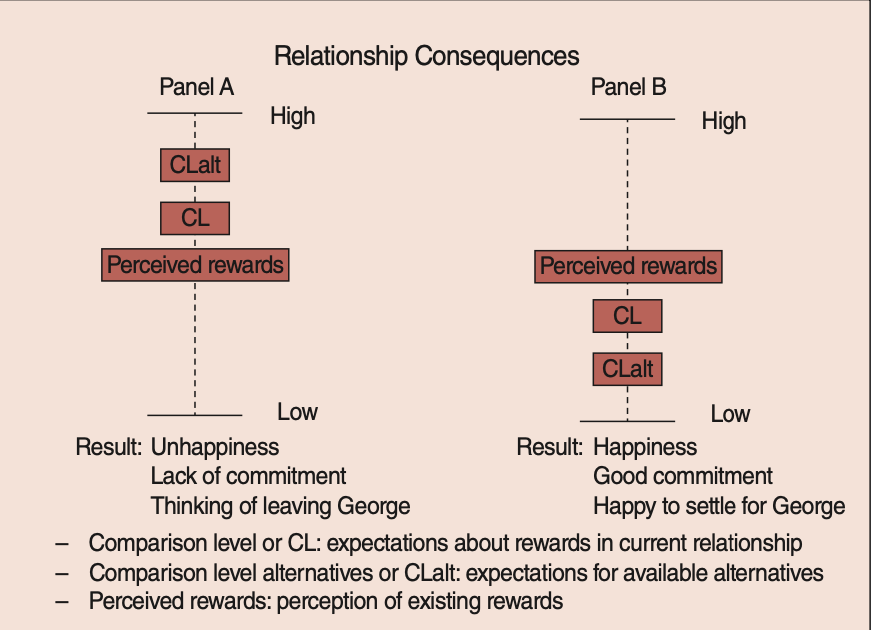
This affects two components, satisfaction and commitment in the relationship.
Comparing CL and perceive rewards determines the satisfaction level.
Comparing CLalt and perceive rewards determines the commitment level.
Power over the partner
This aspect of the theory focuses on the power and influence partners have over one another, and how they respond to one another when their interests either conflict or overlap.
Fate control is when one takes control and the partner has almost no control at all, a surprise party would be an example.
Behaviour control, or mutual behaviour control is when both negotiates about who will do what.
The ‘together’ mindset
Interpersonal attributions are attributes, such as trust, commitment, and attitudes toward one’s partner.
Greater trust, commitment, and more positive partner attitudes facilitate an automatic shift from a selfish mindset to a relationship or partner-centered orientation.